

New study identifies hypoxia resistance as a key advantage of stem cell-derived islets Summary
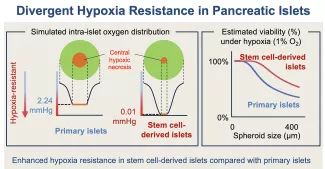
The Komatsu Laboratory at UCSF Department of Surgery recently published a paper in American Journal of Physiology-Cell Physiology demonstrating that human pluripotent stem cell-derived islets exhibit significantly greater resistance to hypoxia compared with primary human islets. Although stem cell-derived cells have generally been assumed to be more tolerant to low-oxygen conditions, direct quantitative evidence supporting this concept has remained limited. In collaboration with California Institute of Technology (Caltech), the laboratory developed a quantitative method to assess hypoxia resistance using a newly established hypoxia-resistance metric. Using this approach, the team directly quantified and compared the hypoxia tolerance of stem cell-derived islets and primary islets.
These findings highlight hypoxia resistance as a potentially important functional advantage of stem cell-derived islets for transplantation. Improved tolerance to low-oxygen environments may reduce early graft loss and expand feasible transplantation sites for future stem cell-derived islet therapies. The study also provides important insights for scalable islet and organoid fabrication strategies in regenerative medicine.
News source: https://pubmed.ncbi.nlm.nih.gov/41870990/